This guide is for Hervey Bay 4WD owners heading over to K'gari (formerly Fraser Island) for a day trip or a camping run. It covers the electrical side of the trip: running a fridge and camp gear from a second battery, charging on sand tracks, protecting wiring from salt and sand, and what to check before and after you cross.
This banner could be yours
Your auto electrical business, front and centre in Hervey Bay
This spot is shown to people looking for auto electrical help anywhere in Hervey Bay.
How can we help?
Need it fixed?
Get a quote from a local K'gari 4WD Trips and Dual Battery Setups from Hervey Bay auto electrician, for anything from a flat battery to a full fit-out.
Get a quoteBuying parts?
Quality auto electrical parts from Ozautoelectrics, an established Australian supplier since 2010, dispatched through a nationwide network. For retail and trade buyers.
Shop partsDoing it yourself?
Free step-by-step guides written for Queensland conditions, with the parts you’ll need listed for each job.
Browse DIY guidesAuto electrician in K'gari 4WD Trips and Dual Battery Setups from Hervey Bay?
Are you an auto electrical business? List your business on this site.
List your business on this siteGetting to K'gari from Hervey Bay
From Hervey Bay, vehicle barges leave River Heads for Kingfisher Bay and Wanggoolba Creek on the western side of the island. Queensland Parks and Wildlife Service (QPWS) lists the crossing at 30 to 50 minutes and says bookings are required. The other vehicle crossing is further south, from Inskip Point near Rainbow Beach to Hook Point.
QPWS says high-clearance 4WD vehicles are essential because the roads are all sand, and recommends low-range capacity. Unregistered vehicles aren't allowed. Every vehicle also needs a valid vehicle access permit before you drive on the island. Rules and conditions change, so read the QPWS before you visit page and the latest conditions report before every trip.
What the island asks of your electrics
K'gari is hard on a vehicle in ways a highway trip isn't. Inland tracks are slow, soft and rutted, so the engine spends a lot of time at low revs while you crawl along. Beach runs bring salt spray and wet sand thrown up into the engine bay and under the vehicle. Then you park for a night or three while the fridge keeps running.
That combination means your charging system works less than you think, your batteries work more than usual, and every plug and connection is exposed to salt and fine sand. A setup that handles a weekend at a caravan park with power may not cope with three nights at a beach camp with no power.
Advertisement
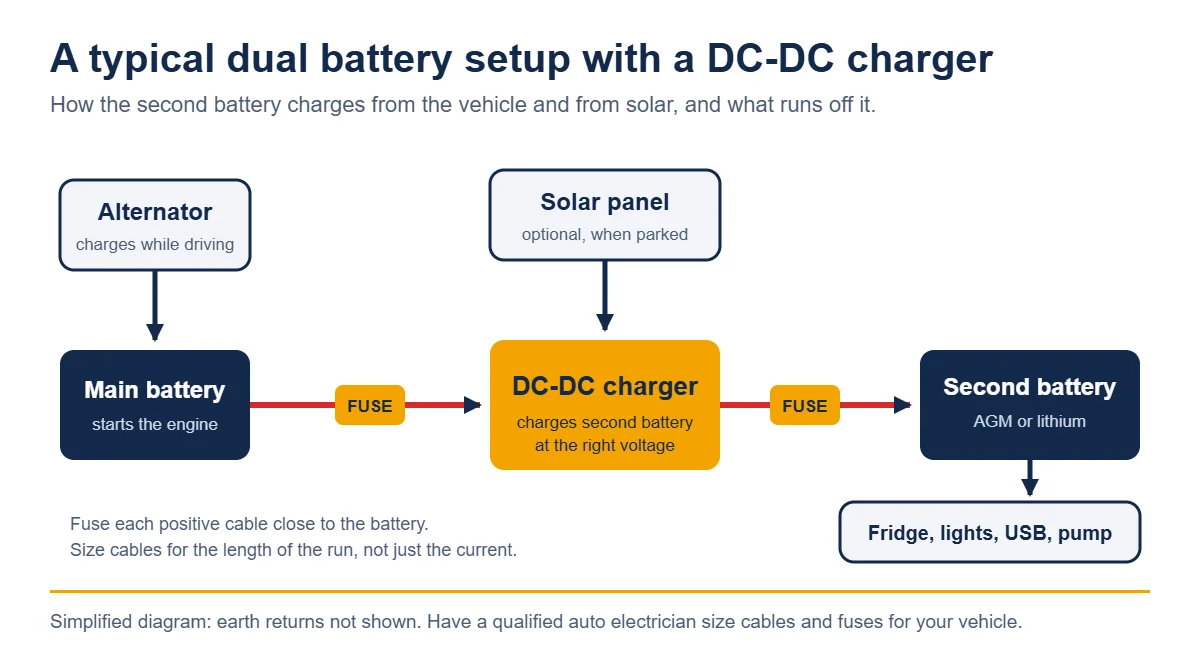
Why a second battery
A 12V fridge is usually the biggest load on a camping trip. Add LED camp lights, phone and camera charging, a water pump and maybe a compressor, and a single starting battery can be flat by the second morning. Being stuck at a beach camp with a vehicle that won't start is the last thing you want, and QPWS points out that recovery on the island is costly and can take hours.
A second battery runs your camp gear and keeps the starting battery separate when the engine is off. Our guide on how a dual battery system works explains the basic layout. Lithium batteries are lighter and handle deep discharge well. AGM batteries cost less and tolerate heat well. Either can work if it's sized for your load and charged properly.
Charging on slow sand tracks
Many newer 4WDs have smart alternators that drop their output once the starting battery is full. A simple isolator may not charge a second battery properly on those vehicles. A DC-DC charger takes whatever the alternator gives and delivers the right charging profile for your auxiliary battery. Our guide comparing a DC-DC charger or isolator goes through the choice.
On K'gari, much of your driving is at low speed, so charging time adds up slowly. Portable or roof-mounted solar is a useful backup, especially if you're staying put for a few days. Remember that a camp under trees gets far less sun than an open beach site.
Building wiring that survives salt and sand
Good wiring on an island setup has a few things in common. It uses the right size cable for the current and the length of the run, it's fused close to every battery, and every joint is sealed against water. It's also mounted firmly, because corrugated tracks shake loose anything held on with a single cable tie.
- Use tinned copper cable where you can, as it resists corrosion better than plain copper
- Crimp and heat-shrink joints rather than twisting and taping them
- Fit dust caps to Anderson plugs at the front bar and rear, and keep them closed
- Mount the second battery in a proper tray or box with a solid hold-down
- Run cables through grommets wherever they pass through metal
- Keep the fuse block and DC-DC charger somewhere dry and easy to reach
Before you book the barge
Give yourself a few weeks if you're having a dual battery fitted, and test the whole system at home before you leave. Run the fridge overnight on the second battery and check the voltage in the morning. Drive for an hour and confirm the battery recharges. Check that your Anderson plugs are clean, your fuses are the right rating and you know where they are. Our guide to wiring an Anderson plug covers the polarity and crimping.
QPWS recommends carrying a spare tyre, a well-equipped tool kit, a tyre gauge and air pump, recovery gear and traction mats. For the electrical side, add spare fuses, a multimeter, cable ties, heat-shrink, contact cleaner and a jump starter. If you run a winch, check the battery, cables and solenoid before you go, because winching takes a lot of current.
Driving rules on the island
QPWS says all inland roads, vehicle tracks and beaches on K'gari are designated roads and Queensland road rules apply. It lists a maximum of 80 km/h on the eastern beach and 30 km/h on inland roads, with lower limits in some beach pedestrian areas. It also recommends driving two hours either side of low tide and warns that deep salt water can stall an engine. These rules and conditions can change, so check the QPWS staying safe page before each trip.
Salt water is especially hard on electrics. A stalled engine in the surf can mean water in the alternator, starter and connectors, as well as a vehicle at risk of being washed away. Plan beach runs around the tides and don't cross water you haven't checked.
After you get back to Hervey Bay
QPWS notes that salt air and spray can corrode vehicles. Wash the underbody, wheel arches and chassis with fresh water as soon as you can after the barge lands. Be careful in the engine bay: use low pressure and keep water away from the alternator, fuse box and plugs. Then lift the bonnet and look at battery terminals, earth straps and connectors. If any have started to go green or white, clean and protect them now rather than after they fail. For common post-trip jobs in Urangan, see our Urangan page.
Parts for this job
Order quality parts online from Ozautoelectrics, dispatched Australia-wide.
Get it done: get a quoteDo it yourself: shop DC-DC chargers
Get it done: get a quoteDo it yourself: shop Anderson plugs
Get it done: get a quoteDo it yourself: shop battery boxes
Get it done: get a quoteDo it yourself: shop tinned cables
Questions Hervey Bay drivers ask
Do I need a dual battery for a day trip to K'gari?
Not usually. On a day trip with no fridge running overnight, a healthy starting battery is generally enough. A portable jump starter is a sensible backup. If you're camping overnight with a fridge, lights and charging, a second battery or a portable power station is worth having so your starting battery stays full.
Will a DC-DC charger work with my smart alternator?
Most current DC-DC chargers are designed to work with smart alternators, often using an ignition-sense wire to know when the engine is running. Check the charger's specifications and your vehicle's manual. If you're not sure how your alternator behaves, an auto electrician can test it and recommend the right setup.
Can I take a camper trailer to K'gari?
Some people do, but towing on soft sand puts extra strain on the vehicle and makes getting bogged more likely. Check current QPWS information and the barge operator's rules before you plan it. If you do tow, make sure the trailer plug and wiring are sealed against salt and sand, and check them after the trip.
Need an auto electrician in Hervey Bay?
Find local auto electricians and mobile services in the Hervey Bay directory, or start with your area: Hervey Bay, Maryborough.
Search auto electrical parts
Searches the full range at Ozautoelectrics, opening in a new tab. Popular: dual battery · LED light bars · trailer plugs · fuses
Run an auto electrical business in K'gari 4WD Trips and Dual Battery Setups from Hervey Bay?
- New to Ozautoelectrics? Apply for trade pricing on quality auto electrical parts.
- Already a trade customer? Log in and order parts at your trade price.
- Want more local customers? List your business on this site so drivers in K'gari 4WD Trips and Dual Battery Setups from Hervey Bay can find you.
Not confident doing this yourself?
There’s no shame in handing it over. A local auto electrician can diagnose the fault properly and get it done safely, especially for anything involving brakes, airbags, hybrid systems or air-con gas.
Get a quote from a local auto electrician Or shop the parts and do it yourself